
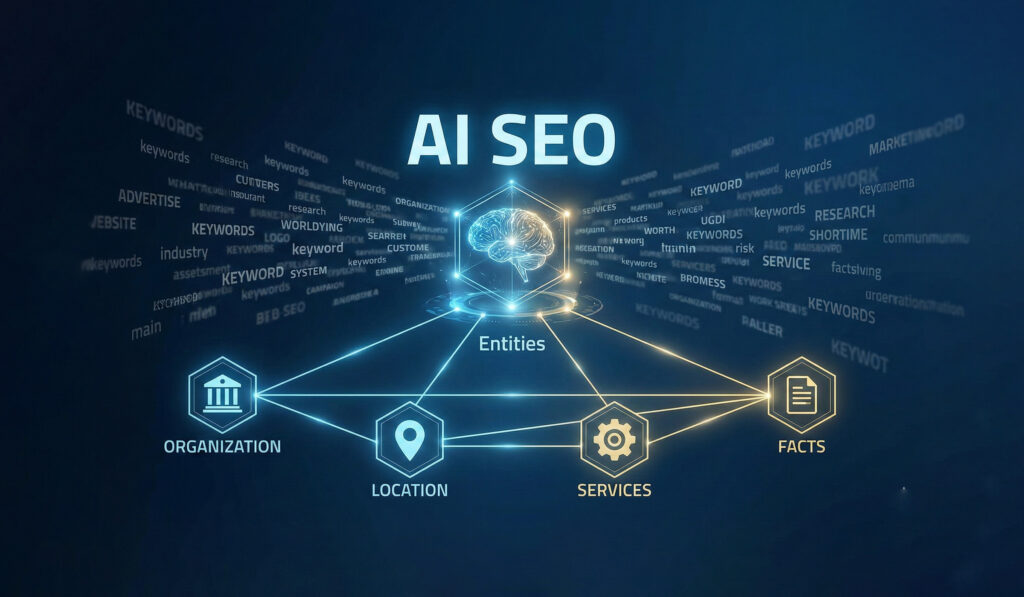
One thing is for certain: AI is changing things. That’s been particularly true in the digital marketing world – a world that’s been primarily based on keywords, volume, competition, and opportunity for the last 30-plus years. But as we’ve discovered at FSM, as we continue to elevate our clients’ online brand presences, keywords are no longer the primary optimization target – they are a side effect of clarity. Typical Search Engine Optimization (SEO) methods, such as On-Page SEO, keyword-based blog posts, and keyword-rich content, are declining as a standalone strategy for growth and visibility. The cause? Answer Engines.
Since the dawn of the internet, tech companies have been trying to get better and better at one thing: finding information relevant to a question. The best way anyone knew how to do that was through keywords. People type some words into a search engine; those words are tracked, and the usage is recorded in search engines. This allowed digital marketers to study those words, figure out which ones people typed most often, how much competition there is, pick out the highest opportunity words, and then implement those words into website content.
The problem with this approach has always been the disconnect between keywords, natural spoken language, and language comprehension. At the end of the day, the words being used aren’t being understood as language; they’re being understood as a pattern of letters. This creates a rift between the words someone types in and what they actually intend or mean. But AI has finally given us a way to tap into nearly all the knowledge of the entire internet through natural language conversation. As we become more familiar and comfortable using AI, the ability to access information without having to pick through search engine results to discover it yourself has created a trend: AI Searches (or Answer Engines) are picking up steam, and traditional keyword-based search is slowing down.
The Rise of the Zero-Click Search
According to a study done by Search Engine Land, 37% of all internet searches now begin with an AI conversation, and 60% of users believe AI provides more thorough and clear answers. Bain Research finds that 80% of internet consumers rely on zero-click answers (essentially, AI summaries at the top of search results) 40% of the time. This trend alone accounts for an estimated 35% decline in clicks to websites. At FSM, we’ve been watching this trend in real-time, so we decided to do something about it.
Introducing AI SEO
Rather than wasting time trying to keep keywords relevant, we’ve shifted our focus almost completely to leveraging Answer Engines as the future of organic traffic growth. But the problem was, it was all theory. When we started researching and testing AI visibility tactics, no tools even existed at the time to help us validate how successful our methods were. Fortunately, digital marketing tools are slowly catching up, and now we can prove our methods. Fun fact, our methods were successful – really successful. We were able to take a brand that showed up 0% of the time in topically relevant AI conversations, and increase that to 58% in just 3 months – going from completely invisible, to the most recommended brand among its competitors.
So that begs the question: “How do you do it?”
How AI Works
We have to start by understanding AI. I don’t claim to understand every inner working of large language models (LLMs), but I do understand what consistently influences their outputs. At the end of the day, AI is simply trying to gather as much information about an entity as it possibly can, then use the information it has – in a way that’s very close to human logic – to weigh the options and pick some winners. So what’s an entity? An entity is basically a noun – it’s a person, place, or thing. It could be your business or organization, your town, the services you provide, or even you (not to scare you or anything!).
So to step waaay back and have a broad view of AI, think of it as a self-generating knowledge-building engine, constantly trying to understand as much as it possibly can, so that it can provide that information back to us with as much accuracy and thoroughness as possible. Knowing that, what we need to do to leverage it is give it information. Lots and lots of information – as much as we can, with as much completeness and clarity as we can.
How to Create Clarity for AI
This is where the fun part came in our research–and it was actually a lot easier than we expected. The first step was to ask. AI was quite eager to teach us all about how it learns, how it makes decisions, what information it weighs more heavily than others, what it would like to see, what it would like to confirm, and what questions it has for us. Through extensive, iterative prompt development and reverse-engineering of their outputs, we discovered how they categorize, validate, and prioritize information. We needed to know what types of prompts generated the highest-confidence answers. Here’s what we found:
- JSON-LD Schema is almost a requirement for your website content
- Start writing content with an entity-first lens, away from keywords
- Provide concrete facts and figures
- Validate that information from sources outside your organization
Now, there’s a lot more that goes into each of those items, which we’ll get to, but these ideas can be broken down like this:
- JSON-LD Schema provides clarity and context to information
- Entity-first content enables direct relationships between your entity and other entities, such as geographic location, service area, services, products, partner businesses, etc.
- Concrete facts and figures provide proof that what you’ve told it is reliable
- External validation confirms it all
So, from a marketing services perspective, what does that actually look like?
AI SEO with FSM
FSM is your strategic AI SEO partner. Working with us opens the door of opportunity to increase AI visibility, taking your organic marketing to the next level. Here’s what you can expect:
- Monthly AI Visibility report and strategy meeting
- 3-Month AI SEO Strategy, identifying the tactics being employed each month
- Regular, high-quality content improvements across your website
- Technical JSON-LD Schema implementation for all content
- Steady improvements in AI Visibility scores that bring in higher quality visits with higher conversion rates
FSM’s strategy to gain visibility for your brand can involve a number of different tactics, including:
- JSON-LD Schema Implementation for Organization, LocalBusiness, Testimonials, FAQPage, Events, Webinars, Articles, Person (for you and key team members), and more
- New, entity-rich content creation for new sections on existing web pages
- Retooled existing content to support stronger entity connections
- Entirely new web pages to cover broader aspects of your industry that are currently absent
- Series of FAQ’s, written with entity-based language, added to all key pages of your website
- Blog articles with long-form AI prompt-based answers
- Even external tactics, like guest blog posts, Reddit community management, review generation, and more
The most important shift AI introduces isn’t technological – it’s the whole philosophical approach. For decades, brands competed for attention by optimizing for machines that matched patterns. Today, brands compete for trust with systems that attempt to understand meaning. In that world, visibility is no longer earned by saying the right words the most often. It’s earned by being clearly understood, consistently validated, and confidently recommended.
AI SEO isn’t a tactic. It’s infrastructure. And the brands that invest in it now won’t just survive the transition – they’ll define their category inside it.
If you’re ready to understand where the gaps in your AI story are and how to close them, we’d love to help. Book a consultation today to get started!