Achieve ADA Accessibility Compliance
Make Your Website Accessible — and Legally Compliant.Digital accessibility helps organizations provide equitable access to online information and services while aligning with ADA Title II requirements and established accessibility standards. Full Spectrum Marketing (FSM) supports improved accessibility, stronger usability, and reduced legal, operational, and reputational risk through practical, scalable solutions.
Why ADA Compliance Matters
Digital accessibility supports equitable access to online information and services, strengthens overall user experience, and helps organizations reduce legal and reputational risk. While ADA Title II establishes accessibility requirements for many public entities, recognized standards such as WCAG increasingly shape expectations across government, education, nonprofit, and commercial organizations delivering digital services.
With 1 in 4 web users in the U.S. living with a disability, inaccessible websites can exclude a significant portion of your audience, create usability barriers, and limit engagement with critical services while increasing potential legal or funding-related risk.
Watch FSM’s ADA Compliance Webinar
Want a deeper understanding of accessibility expectations and what they mean for your organization?
Watch our on-demand ADA Compliance Webinar, where FSM President & CEO Andrew Husted explains ADA Title II considerations, WCAG accessibility standards, and practical steps organizations can take to improve digital accessibility and reduce compliance risk.
If You Need to Be Compliant, We’ve Got You Covered
Organizations can pursue accessibility compliance for many reasons, including ADA obligations, contractual requirements, funding eligibility, risk mitigation, or a commitment to inclusive digital experiences. FSM provides structured support to help you understand your current accessibility posture and build a manageable path toward compliance without disrupting daily operations.
Why Join Through Us?
Through FSM’s group license with Acquia Optimize, organizations can save up to 75% on subscription fees for accessibility software while gaining expert support and mitigation for setup, scans, reporting, and remediation. Our approach helps reduce legal and public risk by addressing issues proactively and keeping your site aligned with ADA requirements.
The FSM ADA Compliance Solution
Our structured framework helps your organization reach ADA compliance — and stay compliant as your website evolves.
How it works:

Initial Audit
Provides a comprehensive evaluation of your website’s accessibility posture.
- Accessibility scan and monitoring dashboard
- Detailed compliance reporting
- Issue prioritization and mitigation roadmap
- Expert review and guidance from FSM

Mitigation
Addresses identified accessibility barriers and supports progress toward ADA compliance.
- Mitigation plan quoted and approved before work begins
- Accessibility improvements implemented by FSM
- Compliance report following mitigation efforts

Ongoing Platform Access
Designed for organizations that are legally required or contractually obligated to maintain accessibility compliance.
- Continuous automated accessibility scans
- Automated reporting and compliance dashboards
- Self-serve tools to monitor new content and website updates
- Identification of mitigation needs as your site evolves
Get a Clear Path to Web Accessibility
FSM’s ADA compliance services help you reduce accessibility risk, enhance site usability, and maintain technical alignment with evolving accessibility standards as your website and digital infrastructure grow.
"*" indicates required fields
Frequently Asked Questions
Does FSM handle accessibility remediation?
Yes. Full Spectrum Marketing (FSM) provides end-to-end accessibility support that extends beyond initial auditing. After identifying accessibility issues, FSM works with your organization to implement remediation strategies that address technical barriers within your website's design, content structure, and functionality.
To help your team maintain compliance going forward, we can set your organization up with automated accessibility monitoring tools. These automated scans and dashboards empower your team to independently monitor newly published content and catch future compliance gaps as your website evolves.
What happens during an ADA accessibility audit?
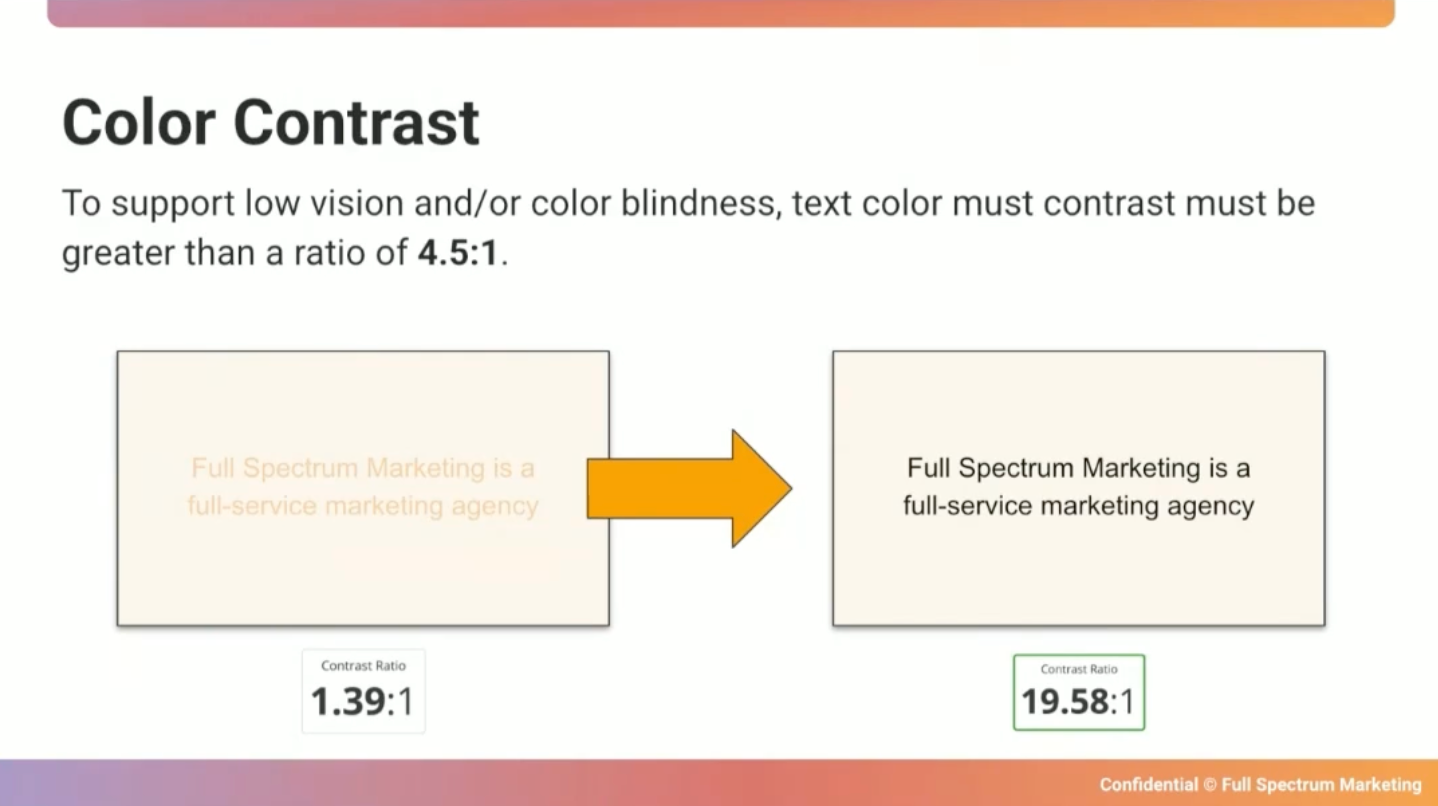
An ADA accessibility audit provides a comprehensive evaluation of how accessible your website is for users with visual, auditory, motor, or cognitive disabilities. During the audit process, automated scanning tools and expert review assess key technical and usability elements across your website, including navigation structure, keyboard accessibility, color contrast, form functionality, image alternative text, heading hierarchy, multimedia accessibility, and screen reader compatibility.
The audit identifies accessibility barriers that may prevent users from interacting fully with your site and maps those findings against established WCAG standards. Organizations receive a detailed report outlining detected issues, severity levels, affected pages or components, and prioritized remediation recommendations from FSM. This process helps leadership teams understand accessibility risk exposure while creating a clear roadmap for improving compliance and user experience performance.
Do nonprofits need to follow ADA accessibility rules?
Yes. Many nonprofits are expected to maintain accessible digital experiences, particularly when they deliver government-funded programs, public services, educational resources, healthcare support, or community-based initiatives. Under ADA Title II, organizations providing services on behalf of state or local governments must ensure their websites and digital platforms are accessible to individuals using assistive technologies.
Even when not explicitly mandated, nonprofits increasingly encounter accessibility expectations tied to grants, procurement requirements, public funding eligibility, and community access standards. Aligning with recognized accessibility frameworks such as WCAG 2.1 AA helps nonprofits provide equitable access to information, improve usability for all visitors, and reduce potential legal or reputational risk associated with inaccessible digital content.