
The New SEO Evolution
Ever since the internet was invented, Search Engine Optimization (SEO) has played a role in all great marketing strategies. Like every other marketing tactic, SEO has seen its fair share of evolutions over time. This new AI era is no different. We are witnessing the next SEO evolution. The main difference, however, is that this new evolution doesn’t only impact Google.
Your customers used to only search on Google, so that was the only place you would see SEO evolve. Nowadays, your customers are searching for you on platforms ranging from Google and ChatGPT to YouTube and TikTok. SEO is now Search Everywhere Optimization because it no longer only impacts search engines like Google.
Your competitors are likely not yet turning their SEO focus toward AI SEO, which leaves a wealth of opportunity for your brand to grow its visibility and get in front of your target customers.
Gone are the days of only creating content to show up on search engines — answer engines, also known as AI engines, have been added to the mix. So what is the difference, what is important, and how do I show up?
Search Engines vs. Answer Engines
The beauty of AI platforms like ChatGPT, Gemini, Perplexity, and Claude is that they think like humans, utilizing natural language interactions. Search engines, on the other hand, are not as friendly to use when you need a quick, direct response. This is why it’s important to know the difference between the two.
Search Engines
The user experience on search engines has always been a bit lacking. Because it’s keyword-focused, your success at receiving results depends completely on searching for the correct keyword or search term.
Then you click through a series of blue links on the response page, hoping to find the solution to whatever problem you’re experiencing — often coming up short.
This is how traditional search functions. Not ideal.
Answer Engines
Simple, clear, and direct responses every time. That’s what answer engines offer to users—a much friendlier experience than traditional search. Usually answer engines provide responses that are compiled from multiple sources, increasing their authority and credibility.
Users can also interact with answer engines using natural language, without having to “guess” the proper keyword that will lead to the desired response. This is a huge benefit as it increases the accessibility of information through these engines.
For marketers and people who care about data, the biggest impact answer engines yield is the ability for users to submit a search, receive an answer, and never click on a thing. This makes attribution even more difficult and unclear. But why does it matter?
The Zero-Click Impact
Since AI engines offer complete and thorough answers every time, fewer users are clicking through to websites to find what they’re looking for. This leaves many marketers and business leaders looking at website traffic, clicks, and CTR (click-through-rate), asking themselves why performance is dropping.
It’s not because your content suddenly sucks—it’s because people are now getting their answers without having to click.
AI is being discussed everywhere you look, and companies are encouraging, if not mandating, their employees to utilize AI platforms as much as possible. This means decision makers will be utilizing AI platforms more and more to make their purchasing decisions.
The biggest question is: will you be visible when your target audience is searching for your solutions on AI platforms?
What Is AI SEO?
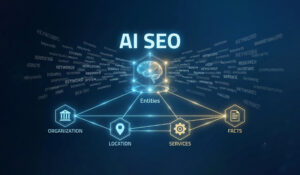
AI SEO is focused on creating quality content by humans, for humans — optimizing it to be discovered and cited by AI platforms. At FSM, we refer to our service as AI SEO, but you might hear it referred to by other names as well:
- AEO – Answer Engine Optimization
- GEO – Generative Engine Optimization
- AIEO – AI Engine Optimization
When it comes to SEO, please don’t listen to the noise that it is dead. SEO is alive and well, but the focus has shifted slightly.
- Rather than focusing on a specific keyword or topic, the focus is now on establishing and building your brand entity online.
- Page rankings are still a good indication, but that only applies to search engines. As the number of users searching on AI engines increases, you’ll want a way to measure your AI visibility and citations.
- Click-through-rate is no longer as reliable as it used to be, which is why you need to turn your attention to earning mentions on review platforms and trusted third-party sources that will position you as a trusted and credible source.
Traditional SEO best practices should not be ignored. They certainly play a part in doing AI SEO well. However, if you want to ride the next great SEO wave and have a high-performing brand, you need to improve your visibility on platforms like ChatGPT, Gemini, Perplexity, and Claude.
The question remains: why does this matter for B2B companies?
Why AI SEO Is Important for B2B Companies
AI SEO is not just the newest trend that’s going to fade soon. AI is here to stay and will continue changing how brands operate. The prominence of AI will continue to grow, and below are a few key reasons why B2B companies cannot ignore AI SEO.
AI Search Is Already Used By Your Buyers
Depending on your specific type of B2B business, who the decision maker and buyer is varies. But whether it’s an executive researching solutions to their biggest problems, procurement teams comparing vendors, or directors looking for a strategic partner, your target audience is using AI more than you think.
Your Competitors Aren’t Doing AI SEO
Everyone is talking about AI and its impacts, but few B2B companies are actually putting AI SEO into practice. This means you have an opportunity to strike first and begin increasing your AI visibility. Not only will this get you in front of your target customers quicker, but if you earn trust with AI first, your brand will stick around for the long haul. The early adopter advantage is real and measurable.
AI Is Well-Suited for Complex B2B Searches
With traditional Google search, the crucial element was always the keyword or search term. With AI engines being natural language-based, you can submit any query, regardless of length, and receive a spot-on response.
In the keyword-focused days, if I were looking for a wine bar, I would have to search “wine bar near me” and receive a generic list of options. If natural wine options and food offerings were important to me, I would have to go through site by site to check whether they offered natural wine and food. But in the AI era, with Google providing AI overviews, I can submit a query like, “what is the best wine bar near me that offers natural wine selections and food,” and receive an in-depth response that provides plenty of info to make an informed decision.
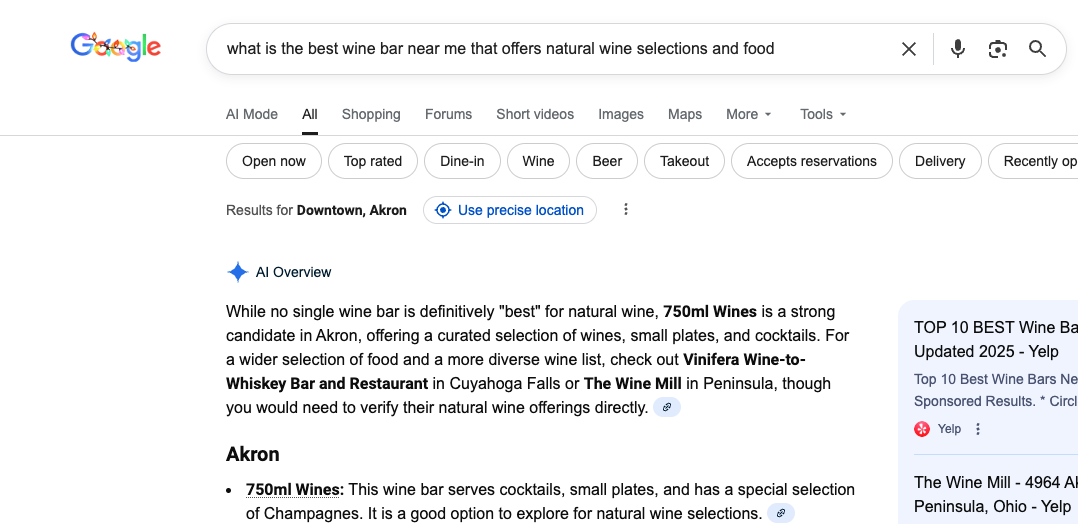
(Brief shout out to 750ml – they’re absolutely phenomenal, have a great selection of wines, and a few of my favorite sommeliers. If you haven’t been before, you should definitely check them out.)
Brand Authority Compounds
AI platforms and tools prioritize sources that are verified, credible, and predominantly authoritative. To be viewed as an authoritative source, being frequently cited is key. Receiving citations is, more often than not, a snowball effect. Once you receive a citation with an AI platform, receiving others is significantly easier. But you need to start somewhere because the sources that AI views as authoritative now will have a strategic advantage in the future. Companies with no citations will be less visible than their competition.
The Impact of Ignoring AI SEO
It’s hard to believe, but as popular as AI is at the moment, it’s only going to continue growing in popularity and use. Now is the time to take advantage of the even playing field and increase your AI visibility. Consumers use search on Google, AI platforms, and social media to conduct research before making a purchase decision. More and more, we are seeing consumers trust the companies that appear in citations from AI platforms.
When companies appear in the research phase for consumers, it increases their likelihood of remaining in the conversation and potentially leading to a purchase. However, if you don’t appear in the research phase, there’s almost a zero-percent chance that consumers will turn to you for a purchase.
The cost of ignoring AI SEO is not as simple as a decrease in visibility. If you ignore AI SEO, you’re leaving money on the table, and it’s all going to your competitors who have the AI advantage.
You have plenty of expertise to share, and your website might list all your capabilities, but just because those are present on your website doesn’t mean they’ll be discoverable on AI. To be discoverable in AI, an intentional approach is required.
How Do I Get Started with AI SEO?
The good news is that the majority of companies have not yet turned to an intentional approach to increase their visibility with AI. That leaves a world of open opportunity for you and your company.
I always recommend beginning with knowing the current state of things. It’s important to know your current AI visibility and whether your company appears in the high-value queries that are vital for you to show up.
Go to your preferred AI platform and submit a query that includes the most specific information your company needs to be showing up for. I like to include a combination of these topics:
- Industry
- Target Audience
- Core Capabilities
- Geographic Region
Using FSM as an example, if I wanted to identify our current AI visibility for those items above, I would submit a query like:
“I am the VP of Marketing for a B2B manufacturing company looking for a marketing agency to handle ongoing marketing services for our company. The agency needs to offer PPC advertising, AI SEO, and Website Development Services. We’re based in Akron, OH, so I would like for you to produce a list of marketing agencies in that same geographic area according to the capabilities we are looking for.”
After conducting this search, I noticed we were not included in the original list of suggestions. So I proceeded to ask ChatGPT why we were not recommended, and it provided me with a step-by-step guide for website optimizations that could help increase our AI visibility.
Knowing what to optimize is one thing, but knowing how to optimize it is another thing entirely. It’s a very specialized approach, and FSM is here to be your partner for diving into AI SEO.
AI SEO with FSM
AI search is here, and FSM wants your company to be an early adopter.
Your customers are already using AI to make purchase decisions, and if you haven’t started optimizing your website for AI visibility, you need to start as soon as possible.
If you’re interested in diving into your AI visibility and beginning AI SEO for your business, FSM is a proven authority in this space, and we are positioned to help you improve your AI visibility.
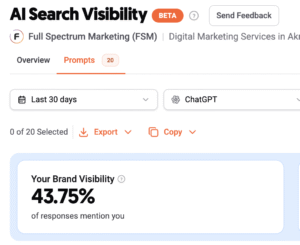
When FSM began AI SEO ourselves, we had a 0% AI visibility score. After three months of work, we increased our score to 43.75%. There are tons of opportunities for your company to experience similar results.
I want your customers to discover you when they’re researching to make a buying decision — and AI is key to increasing your company’s visability.
Are you well-positioned for the increased use of AI?